From Sketchbook to Exhibition: The Changing Role of the Artist’s Study
An artist’s study can move from private rehearsal to public object. Learn how purpose, material and display change what viewers expect from it.
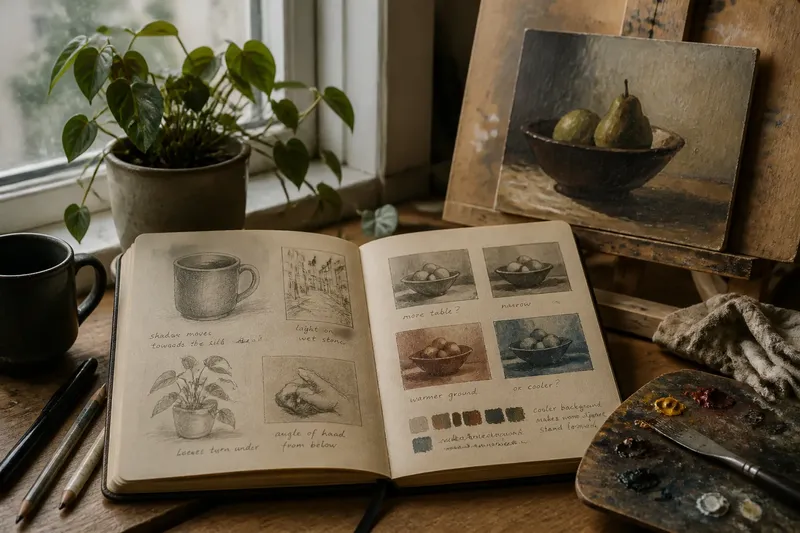
A sketchbook lies open beside a kitchen window, where a plant shifts in the draught. An artist’s study can begin as a quick record of that movement, then become a test for a larger work or an object worth showing in its own right. Its purpose changes as the artist revisits it and decides who else might see it.
A study is not simply a smaller, less polished version of a finished work. It may be incomplete by design, or complete in the task it set itself. A drawing made to remember the angle of a hand can do its job without becoming a composition. A resolved oil study may also stand on its own, even if it began as preparation.
Week One: Keep a Record
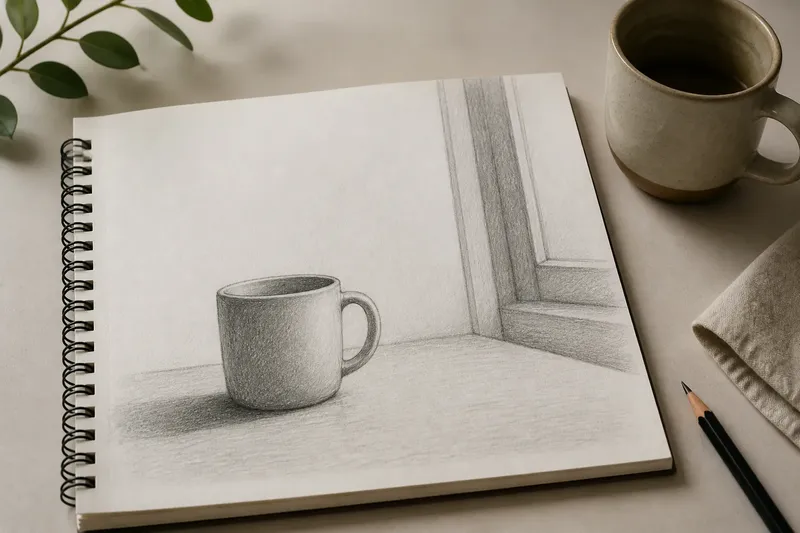
For the first week, use the sketchbook as an aide-mémoire rather than a performance space. Choose an ordinary subject: a mug, a street corner, a folded coat, or a neighbour’s plant viewed with permission. Return to it on several days. Note what changes and what stays put.
Use materials suited to quick decisions. A soft pencil records shifts in outline; a pen can pin down a turn or overlap; toned paper lets a few marks carry the main impression. Add words when they preserve information a drawing cannot: “shadow moves towards the sill”, “handle catches the light”, or “leaves turn under”. These are prompts for future attention, not captions.
Keep the pages beside each other, but do not make them artificially consistent. One drawing can be a contour, another a shaded patch, another a handful of written observations. If every page is made presentable, the book starts recording your idea of what a sketchbook ought to look like rather than what you noticed.
At the end of the week, look through the pages once. Mark details you may need later, not the pages you like best. Those are different judgements. A rough note about a reflected window may be more useful to a painting than the most pleasing little drawing in the book.
Week Two: Test Decisions
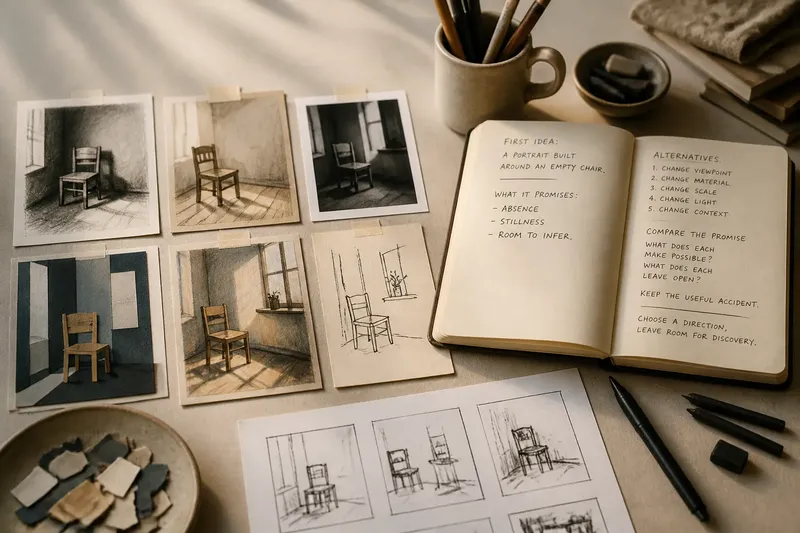
In the second week, select one recorded subject and ask a narrow question. How much of the room should remain visible? Does the figure read more clearly from the side? Would a colder ground make the warm object stand forward? A study becomes useful when its question can be stated plainly enough to affect what you do next.
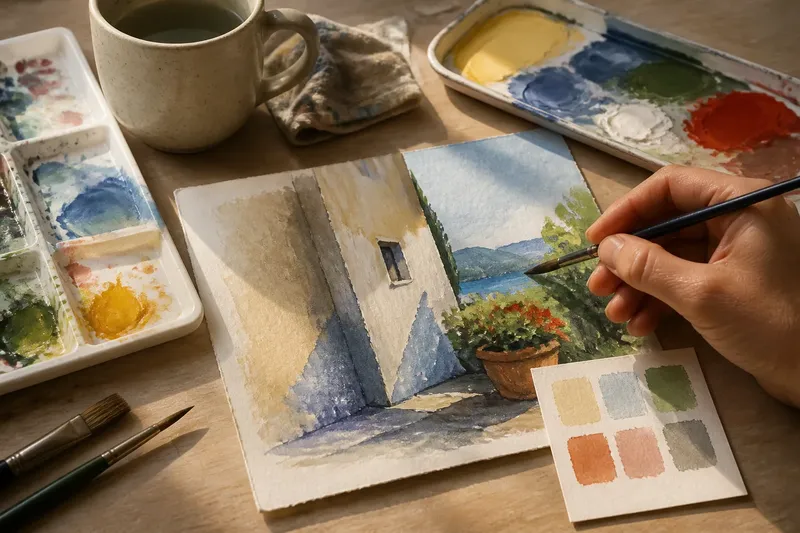
Make modest trials rather than one miniature masterpiece. Change one decision at a time where practical: crop, viewpoint, tonal arrangement, material or scale. A graphite thumbnail can test the broad arrangement; a charcoal block-in can test mass; a small patch of colour on prepared paper can test a palette. Record the choice each trial examines. Without that note, similar-looking marks may answer quite different questions.
Say you have drawn a bowl of pears and want to know whether the table should occupy more of the picture. Make two small studies from the same viewpoint, one with a narrow strip of table and one with a broader plane. If the broader version gives the fruit a clearer sense of weight, that is an observable reason to carry the decision forward; it does not settle every other question about the eventual work.
Some trials will be awkward, and that is not a fault to disguise. A study can expose a bad assumption cheaply. If the paper buckles under a wet medium, or the viewpoint hides the feature you meant to examine, record the problem and change the conditions. It is not worth polishing a trial that has stopped answering its question.
Week Three: Develop a Work
During the third week, carry one useful finding into a more sustained piece. The larger work may borrow the study’s arrangement, revise its colour, or discard its subject while retaining a discovered shape or rhythm.
Before beginning, write a short note on what the study has established and what remains open. “Keep the low viewpoint; decide the background in paint” is more helpful than “use the study”. That vague instruction can turn a provisional decision into a rule. A working drawing should inform the next piece, not issue orders from the sketchbook.
Keep the study available, but avoid copying it mechanically. Look back and forth between the two surfaces. The original answer may no longer serve the larger work, whose scale, material and viewing distance can change how a mark behaves. A faint pencil line that held the small study together may vanish on a broad canvas; a spare note about the shadow may matter more than the exact contour.
Keep a separate record of changes as they happen. A dated page, quick diagram or few sentences can show why the developed piece diverged. This helps distinguish a purposeful decision from an accidental detail that proved worth keeping.
Week Four: Choose What Travels
In the fourth week, review the study and the developed work as related objects. Ask what each offers a viewer. The larger work may invite sustained attention to a subject; the study may show an experiment, a compressed observation or a kind of touch that the finished work no longer contains. Neither role is automatically more important.
Selection for display is not a prize ceremony for the neatest page. Decide first whether the study has enough visual and material coherence to meet an audience without relying entirely on explanation. Then consider what context would make its purpose legible. A drawing pinned beside a finished painting may read as preparation. Isolated on a wall with a title, it may be received as an independent work. Display changes the question viewers bring to it.
Check the paper, surface and edges before considering a frame or mount. A torn page may carry evidence of use that belongs to the object, or it may distract from the marks. Tape, folds and annotations can be part of the study’s history, but there is no need to preserve every mishap as though it were a meaningful artistic decision. For handling, framing, conservation and display, follow the medium’s care guidance and consult a conservator or gallery professional where the material is fragile or unfamiliar.
Keep the sketchbook’s order in mind. A removed page loses the neighbours that may explain its purpose. A photograph or brief note about its original place can preserve some of that relationship, while the page is presented separately. A study need not leave the book, and a page that stays private has not failed to become art.
Questions About Studies?
How is a study different from a finished work?
A study is defined chiefly by its job: testing, recording or developing an idea. A finished work is generally intended to stand as a resolved object, though a study may feel complete in its own terms and be shown independently.
Can a study be exhibited on its own?
Yes, if its material presence and visual choices offer viewers something to attend to beyond its usefulness to another work. Clear display and concise context can help, but the study need not be presented as a lesser version of a larger piece.
Should a preparatory study be kept after the main work is complete?
Keep it if it records decisions, material knowledge or a useful change of direction. If it contains only information preserved elsewhere, keeping it is a practical choice rather than a duty.
Does every finished work need a study?
No. Some works develop through direct making, conversation, memory or repeated adjustment on the final surface. A study is one possible tool, not an entrance fee to serious work.
After the Month
Once the four weeks are over, the sketchbook can return to its less orderly life. Leave room for unrelated observations and unfinished thoughts. The routine makes one subject’s passage from record to trial to possible display easier to notice; it need not turn every page into a production schedule.
When you next open a sketchbook, ask what you need the page to help you see. The answer may be a reminder, a test, or the beginning of a work intended for other people. Naming that purpose gives an artist’s study room to change without pretending it was always heading towards an exhibition.