The Myth of the First Idea as the Best Idea
The first idea in a creative project can feel vivid but narrow. Compare alternatives with simple prompts to find a direction that keeps its spark.
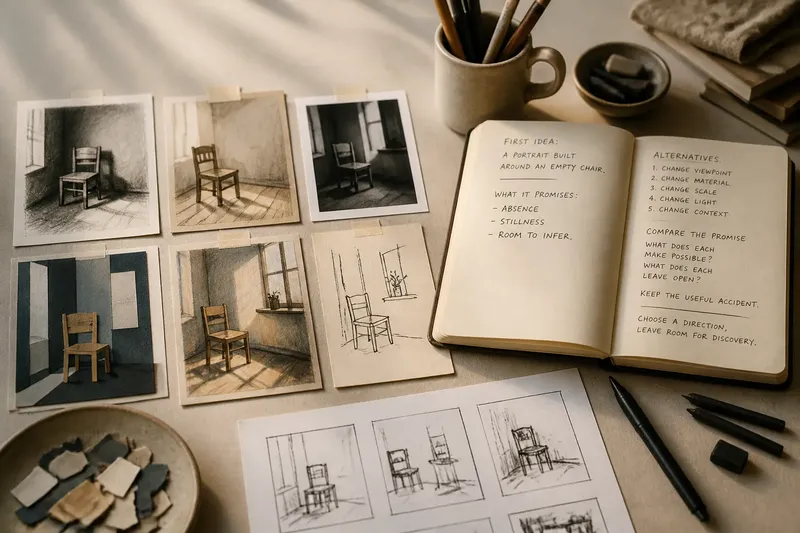
The first idea in a creative project often arrives with a satisfying click: a title, an image, a phrase that seems to gather the whole work into itself. That feeling is useful, but it is not a verdict. Setting the idea beside alternatives can preserve its spontaneity while showing what else the work might become.
Here are five ways to compare early impulses without turning a lively beginning into a committee meeting with yourself.
1. Separate arrival from judgement
A first idea has the advantage of arriving before its complications. It is still free of the awkward transitions, material limits and practical choices that appear once you begin. That freshness can make it seem unusually complete. Often it is simply the only possibility currently in view.
Write the idea down in the form in which it arrived: a sentence, a rough thumbnail, a scrap of dialogue. Avoid polishing it immediately. Then give it a plain description of what it appears to promise. “A portrait built around an empty chair” is more useful than “a haunting meditation on absence”, which has already started directing the audience’s response.
This pause does not demote the idea. It gives you something stable to compare with later possibilities. The original may remain the strongest direction, but now it has to earn that position by what it can do, rather than by having turned up first.
2. Change one condition
Generate alternatives by changing a single condition at a time. If the first impulse is to make a quiet charcoal portrait, keep the subject but change the scale, the point of view or the material. A small alteration can expose whether the idea depends on one particular feature or has room to develop.
For a written piece, change the speaker or the setting while keeping the central situation. For a short film, retain the image but alter what the camera is allowed to show. For a clay object, keep its intended use and change its balance or surface. These are not invitations to scatter the project across unrelated possibilities; they are controlled variations that make comparison easier.
Say you begin with a drawing of a closed shop at dusk. You might keep the storefront but draw it from inside, with the street reflected in the glass, or replace the charcoal with cut paper. The first view may still be the clearest, but the reflected street could introduce a more active relation between the empty shop and the life outside. That is an observable difference in the work, not a claim that one version is universally better.
3. Compare the promise
Put each candidate into a compact form: a thumbnail, a few sentences, a material sample or a rough scene. Then ask what each one makes possible. Does it create a useful tension? Does it give the audience something to infer, or does it explain the point too quickly? Can it sustain attention beyond the first striking image?
Compare the work’s promise, not its polish. A finished-looking sketch can win simply because it has already received more attention. Keep alternatives at a similar level of development, and use the same basic question for each: what might this direction let the work do that the others cannot?
It helps to name the difference rather than rank the options. One version may be intimate, another comic, another more ambiguous. Those descriptions are not scores. They show the kind of experience each direction is offering, which makes it easier to choose with intention.
4. Keep the useful accident
Spontaneity is not a fragile object that must be sealed away from thought. It can survive revision, and sometimes it becomes clearer through it. The important distinction is between examining an impulse and sanding away everything that made it alive.
When a variation seems promising, identify what should remain from the first idea. It might be an odd colour pairing, a blunt phrase, an unstable composition or a sense of mischief. Carry that feature into the alternative rather than treating the original as an all-or-nothing package.
Conversely, if the first idea’s force depends on one surprising detail, protect that detail from unnecessary explanation. A little restraint can do more than adding a note that tells the viewer what to feel. The work need not account for every choice like a witness under polite questioning.
5. Choose a direction?
How many alternatives should you make?
Make enough to create a genuine comparison, not so many that choosing becomes a separate project. A few distinct options are usually more revealing than a long row of near-identical refinements.
Should you keep the first idea?
Keep it if it remains compelling after you have seen what it excludes and what it enables. The point is not to punish an early arrival for being early; it is to distinguish conviction from familiarity.
What if every alternative feels weaker?
That may mean the first idea is well suited to the work, or that the alternatives have changed too little to test it. Try varying the audience’s point of view or the medium’s role before deciding that the field is settled.
When is an idea ready to develop?
Develop it when you can name what interests you and what question remains open. You do not need a complete explanation of the finished work; you need a direction that offers meaningful choices as you make it.
Leave room for discovery
Choosing is not the same as predicting every result. A direction can be strong because it gives you worthwhile material to work with, not because it promises a tidy destination. Keep the rejected sketches or notes nearby if they contain details that may later prove useful, but do not let them become a second project demanding equal attention.
There is little value in producing alternatives just to demonstrate that you can. If a comparison reveals nothing new, stop. The useful question is not whether the first idea was best from the beginning, but whether it still seems alive after other possibilities have had a fair hearing.
The first idea in a creative project is a beginning with particular advantages: freshness, speed and a direct line to the impulse that started the work. Treat it as evidence, not authority. That small distinction lets the original spark remain, while giving a better direction the chance to appear.