Watercolour or Gouache for a Small Colour Study?
Watercolour or gouache for a small colour study? Compare how each handles paper, layering and corrections, then choose a paint that suits the image.
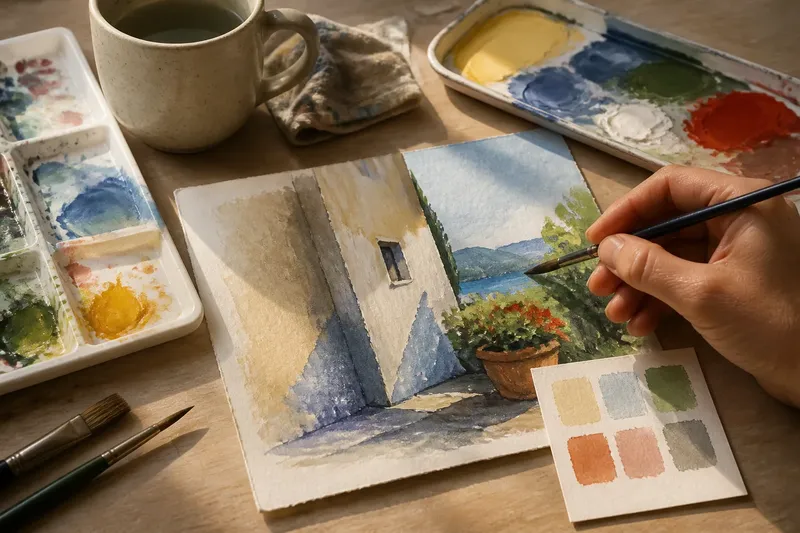
You have a scrap of watercolour paper, a limited patch of afternoon light and a mug that is not quite far enough from the palette. For a small colour study, the choice between watercolour and gouache often comes down to a practical question: should the paper show through, or should the paint cover it? Both are water-based, but they behave differently when a wash dries, a colour needs changing or a brush returns to a damp patch.
A study need not be polished or precious. It can be a quick way to settle the relationship between a warm wall and a cool shadow, or to see whether a red object sits comfortably beside a green one. Trouble usually starts when the paint is asked to behave like its neighbour. The useful response is not to declare one medium superior, but to identify what the surface is doing and adjust the next mark.
Choose by the surface
Watercolour is transparent or semi-transparent, depending on the pigment and how it is mixed. Its colour is built with thin passages of paint, and the white paper supplies much of the light. A pale yellow can therefore remain luminous without white pigment in the mixture, provided the paper beneath it is clean and bright.
Gouache is an opaque water-based paint. It commonly contains a larger proportion of pigment and a binder formulation that allows paint to cover what lies beneath. A light shape can sit over a darker one, which makes it handy for a study where the colours need to be moved around rather than carefully reserved from the start.
Neither label describes every tube perfectly. Watercolour pigments vary in transparency, staining and granulation; gouache colours vary in coverage and handling. A small test patch on the paper you plan to use tells you more than the colour name alone. Paper matters too: watercolour paper has a surface and absorbency suited to wet media, while thin sketch paper may buckle, pill or show marks through from the other side.
For a small study, choose watercolour when the image depends on clear light, visible paper and layered washes. Choose gouache when you want flatter areas, light marks over dark ones, or room to revise the arrangement. A mixed approach is possible, but it is easier to understand what the paint is doing if you begin with one medium and add the other only for a specific reason.
When washes turn patchy
A watercolour wash can dry with hard edges, pale gaps or uneven blooms. Often the brush has run low on paint midway across a shape, or the paper has begun to dry before the wash was completed. Adding water to one isolated spot can leave a tide mark as the wet area pushes into the drying edge.
For the next passage, mix enough colour before touching the paper. Use a brush that can carry the wash across the shape, and work from one edge to the other without pausing to repair every small variation. If the paper is already partly dry, let it dry fully before deciding whether another layer will help. A second, controlled wash can unify a shape; repeated scrubbing usually disturbs the paper and lifts colour unevenly.
Some variation is not a fault. A soft shift in a wall or sky may be useful, while a blotch across a carefully observed object may distract. If the wash is meant to be flat, keep the paper level and avoid returning to the same area as it dries. If a slight grain or bloom suits the study, there is no need to spend the afternoon trying to iron it out.
When the paper looks too dark
Watercolour is difficult to lighten by painting white over it, because the medium relies on the paper for its brightest notes. A shape can become too dark after successive layers, especially if each colour looked lighter while wet. Watercolour commonly dries lighter, but the exact change depends on pigment, paper and the amount of water in the brush.
Begin by leaving the area alone until it is dry. A damp surface can make a lift or correction larger than intended. If the paper and pigment allow it, a clean, barely damp brush may soften a small edge or lift a little colour; blot it gently with a clean cloth or tissue rather than rubbing. Some pigments stain the paper and resist lifting, so treat this as a modest adjustment, not a reset button.
For the next layer, place a test stroke beside the study or on a matching scrap. If the test dries too strong, dilute the mixture or use a lighter touch. It is also possible to preserve the white paper from the beginning by painting around small highlights. For a casual study, a little missed white is rarely worth repainting the whole image; a deliberate pale shape can often be carried elsewhere to make the composition feel consistent.
When gouache turns streaky
Gouache can show brush marks when the mixture is too thick, too dry or spread over an absorbent surface. A brush that has been dragged across a nearly dry patch may leave broken tracks rather than a smooth block. On the other hand, a very watery mix can become transparent and lose the opaque coverage expected from the paint.
Try a fresh mixture with enough water to move freely but enough paint to remain visibly opaque. Lay the shape down with a brush suited to its size, then leave it to settle. The ideal consistency depends on the pigment, brush and paper; a test mark is a sensible way to judge it. If a second coat is needed, wait until the first is dry and apply the next pass evenly rather than repeatedly brushing the same damp patch.
Gouache can reactivate with water after drying. That makes it possible to soften a mark, but it also means a wet brush can disturb an underlying colour. When painting a light shape over a dark one, use a reasonably opaque mix and a light hand. If the lower layer begins to show through, stop before the surface becomes muddy; let it dry, then add a more controlled pass.
When corrections make mud
Both paints can become dull when too many colours are mixed or layered without a clear plan. In watercolour, repeated wetting may lift earlier paint or mix colour at the edge of a new wash. In gouache, returning to a damp area can pull the lower layer into the new one. The resulting colour may be less clear than either mixture that went into it.
Before correcting a shape, ask what is actually wrong: its hue, its value, its edge or its size. Changing one feature at a time is easier to read than repainting the whole passage. If the colour is wrong but the shape is right, a fresh, simple layer may help. If the edge is the problem, soften or sharpen only that boundary. If the surface has become overworked, leave it and make the next decision elsewhere in the study.
Keep a scrap of the same paper nearby for mixtures and brush checks. It is a modest tool, but it prevents the main image from becoming the place where every uncertain colour is tried. A palette with separate wells also helps keep clean mixtures away from old, drying paint. What is not worth the effort is chasing a perfectly uniform surface in every small study: a slight change of texture can do less harm than a succession of corrective coats.
Which paint suits the problem?
Say you want to study a bowl of plums against a pale kitchen wall. If the main question is how light passes through the reflected colour on the wall, watercolour lets the paper contribute to the light and supports transparent layers. If the question is whether a pale bowl shape will read against a dark cloth, gouache offers direct opaque coverage and allows the bowl to be placed over the first dark block. Either choice can describe the scene; each makes a different correction easier.
For a small, low-pressure study, a useful order is to identify the main colour problem, choose the paint whose surface behaviour suits it, then make a test mark before committing to the main sheet. With watercolour, reserve the lightest paper areas and build colour gradually. With gouache, establish a workable opaque mixture and let passages dry before layering over them. Keep the scale modest enough that the study remains a place to make decisions, not a miniature performance.
If the paper label, paint label or manufacturer’s directions specify a particular surface or handling method, follow those directions for that product. Some water-based paints are formulated differently from standard artist’s watercolour or gouache, and the name on the tube is not a substitute for reading it.
Questions about paint choice?
Can watercolour and gouache share one study?
They can, but use each for a clear purpose rather than mixing them indiscriminately. Watercolour can provide transparent washes, with gouache reserved for an opaque accent or a correction that needs coverage.
Is gouache easier for beginners?
It may feel more forgiving when a shape needs to be covered or moved, while watercolour can be simpler when the design depends on leaving paper white. Neither removes the need to watch how much water is on the brush.
Can watercolour be painted over with gouache?
Gouache can usually cover a dry watercolour passage, though the amount of coverage depends on the colour and consistency. Test on a scrap first if the underlying layer is important or the surface is delicate.
What paper works for a colour study?
Watercolour paper is a dependable starting point for either medium because it is made to handle wet paint. A smoother surface can suit crisp gouache marks, while a textured sheet gives washes and brushwork a more visible grain.
For the next watercolour or gouache small colour study, let the image’s main difficulty make the choice: transparent light points towards watercolour, while covered shapes and easy colour revision point towards gouache. The scrap beside the palette can settle the final doubt. It is less dramatic than intuition, and considerably cheaper than repainting the study.